Is there such a thing as an affordable Leica in 2026? And if it is affordable, is it any good?
The Leica X2 gets mentioned regularly across the internet as one of the cheapest ways into the Leica system. It's an old model now — released back in May 2012 here in the UK — and it's currently sitting on the used market at somewhere between £700 and £1000+, depending on where you buy it and what condition you're willing to accept. I'm not going to dive deep into specs here because the camera has been around long enough that there's a ton of sites who've already done that job thoroughly. What I want to talk about is whether it's actually worth owning in 2026 — from someone who owned one, shot with it, and made a decision about it.
For context, the X2 uses a 16.2 megapixel APS-C CMOS sensor. More than enough for most people, even in today's world where manufacturers seem to think nobody can function with fewer than 40 megapixels.

Why I Actually Bought One
There were a few reasons I picked up a Leica X2, and I'll be honest about all of them.
First — it was cheap. I paid around £575 for mine because it had a few dead pixels on the rear screen. For most people that would be a dealbreaker. For me it wasn't, because I already had an Olympus VF-2 clip-on viewfinder sitting in my box of bits, which meant I wasn't going to be relying on the rear screen much anyway. Buying a camera with a cosmetic screen fault to get it under a certain price — I've done worse.
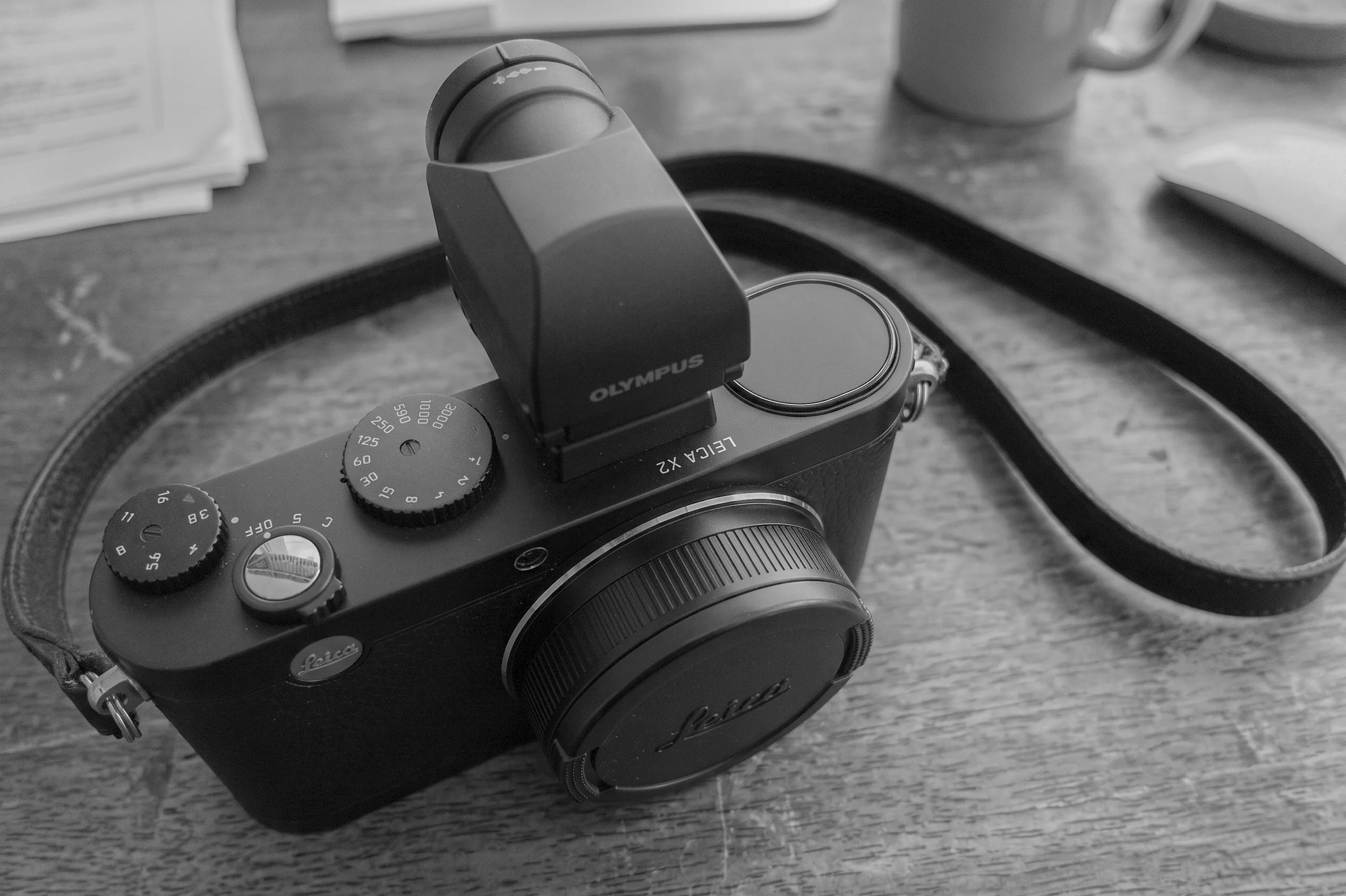
Second — the size. The X2 is a genuinely compact camera. Nice pocketable dimensions, substantial enough to feel like a proper camera in your hand, light enough to carry without thinking about it. Then I attached the VF-2. Suddenly it wasn't quite the sleek little street companion I'd imagined. It looked a bit like something a toddler had bolted together from two different camera kits. Functional, yes. Beautiful, no.
Third — and this one is going to sound odd to a lot of people — it has absolutely zero video functionality. None. No video mode. No red record button lurking in the menu somewhere. No embarrassing moments of accidentally filming the inside of your jacket pocket. I use cameras for photography and photography only, so the complete absence of video features was genuinely appealing to me. When you don't need video, you don't need the menus, the settings, the extra buttons, any of it. The X2 just skips all of that entirely. I loved it.
Fourth — the question I'd always wondered about but never paid to answer — is there actually a 'Leica look'? At the price I paid, it felt like a reasonable amount of money to spend finding out.
What the X2 Is (and Isn't)
This camera doesn't have many features. If you're someone who enjoys diving into menus, toggling through options, setting custom buttons, or generally tinkering — you're going to be very disappointed. I don't say that lightly. You are going to hate this camera.
But if you're into simplicity? If you'd rather have fewer options so you can just get on with taking photographs? You're probably going to be very happy. The X2 strips things back in a way that feels deliberate rather than lazy.
The top plate gives you a shutter speed dial, an aperture dial, and an on/off switch that surrounds the shutter release button. I will say — I did find myself accidentally switching the camera on when putting it back in my bag more than once. Worth knowing before you assume the battery's dead.
Around the back, the layout is sensible enough. On the left you've got a playback button, a delete button, and buttons for white balance, ISO and info. On the right, there's a rear dial — but it only works within the menu system, not in conventional shooting mode, which takes a bit of getting used to. Below that, a four-way keypad handles the menu, flash, AF/MF, self-timer, and exposure compensation. Everything is placed well. After a bit of time with the camera it all becomes instinctive. No complaints about the physical handling at all — it's a nicely put-together thing.

The Concerns I Had Going In
When I bought the X2 there were three things I was already thinking about.
Fixed focal length. The X2 has a fixed Leica Elmarit 24mm f/2.8 ASPH lens. Because it uses an APS-C sensor, that gives you a 35mm equivalent of 36mm — close to 40mm, which is actually one of my favourite focal lengths. In theory, that should have suited me. In practice, I shoot across a few different genres and I'm not always in a position to let my feet do the zooming. A fixed lens asks you to commit. Some days you can. Some days you can't. This was always going to be a potential problem for how I work, and if I'm being honest with myself, I knew that even before I handed over the money. It's a compromise I walked into with open eyes.
Autofocus. The internet has plenty to say about the X2's autofocus, and not much of it is flattering. Having now used the camera — yes, there's something in it. It missed focus sometimes. It refused to lock on occasionally. For anyone doing any kind of fast or continuous shooting this would be a genuine issue. For me, shooting single shot only and working at a fairly considered pace, I could live with it most of the time. It wasn't the disaster the forums make it sound, but it's not sharp and instant either. Go in knowing that.
No built-in viewfinder. Less of an issue for me because of the VF-2, but worth flagging for anyone without one. The rear screen on the X2 is not great. In bright sunlight it's close to unusable. If you're someone who shoots from the rear screen by default, this camera is going to frustrate you in good light — which is precisely when you want to be out shooting. The VF-2 sorted this for me, even if it added some bulk and looks a bit awkward attached to the top. Functionally it works well. The shooting experience through a viewfinder is always more immersive anyway — I'd rather have that than squinting at a screen.
The Image Quality
This is where the X2 makes its argument, and it's a decent one.
I only ever shot black and white with this camera — JPEG straight out of the camera, which is how I set all my cameras up. The black and white output was more than I could grumble about. Sharp, with good tonal range and the kind of rendering that justified having the lens name on the front. I can't speak about the colour output because I didn't shoot any. That's just how I work.
One thing to note — the in-camera black & white JPEG options are pretty limited, even by the standards of other cameras from the same era. You've basically got sharpness and contrast to play with. That's it. For a lot of people that might feel restrictive. For me, with a bit of post-processing in Snapseed if something needs a tweak, it wasn't an issue. The base material is good enough that you don't need much.
And is there a Leica look? Honestly, there probably is something — a particular quality to the rendering that's hard to pin down precisely. Whether that's the lens, the sensor, the JPEG processing, or just the way you shoot when you're carrying a camera with a red dot on it, I couldn't tell you definitively. What I can say is that the images from the X2 had a character to them that I liked. Whether you could distinguish them from images shot on something else in a blind test is a different question.

Would I Buy Another One?
I enjoyed owning the X2. It met the expectations I had for it, and for the price I paid it gave me a good experience and some images I was happy with. But I didn't keep it. The fixed focal length was always going to catch up with me, and it did. It wasn't a surprise — I knew that going in. The camera did everything it promised, it just didn't promise quite enough for the way I work day to day.
Would I buy another Leica? Yes — probably. The X2 gave me enough of a taste of what the fuss is about that I'd be willing to go back at some point. But any Leica purchase needs to be justified carefully, even the 'affordable' ones. These cameras have nudged upward in price over the last year or two. The £575 I paid was good value for the condition I accepted. At the top end of that used market range, you'd need to be genuinely committed to the experience to make the numbers work.
The Leica X2 in 2026 — it's not a camera for everyone, and it was never trying to be. If you want simplicity, a great lens, no distractions, and you shoot in a measured and deliberate way, it has real appeal. If you need versatility, reliable autofocus, or a camera that does more than the basics — look elsewhere.
For me? It was a worthwhile chapter. The camera I wanted it to be, just not quite the camera I needed it to be.
Looking for one now? Check current used Leica X2 prices on eBay.
This page contains affiliate links. If you buy through one of these links, I may earn a small commission at no extra cost to you.