The term street photography has been around longer than most people realise. The Oxford English Dictionary traces its earliest known use to 1858, a citation in the Journal of the Photographic Society. That's nearly 170 years ago. Photography itself was barely twenty years old. There were no smartphones, no YouTube tutorials, no Instagram reels showing you how to nail the perfect decisive moment. Just photographers, streets, and whatever light happened to be there.
So when I found myself going down a rabbit hole of definitions, history, and Google / Flickr image searches in preparation for this blog, what I was really asking was a simple question: does what we call street photography today have anything to do with what they meant in 1858? And does the version of it that dominates the internet bear any real resemblance to either?
To be honest with you — I'm not sure it does.
What the Definition Actually Says
Ask most people what street photography is and they'll describe something involving a stranger caught mid-stride in a city, rendered in high contrast black and white, probably slightly blurry, possibly looking intensely at something off-camera. That image exists so vividly in the collective imagination that it has almost become a logo for the genre.
But the actual definition is far more interesting and far more open than that.
At its core, street photography is about capturing unmediated, candid moments of everyday life in public spaces. Not just streets. Not necessarily cities. Not even necessarily people — objects and environments can count, provided they carry a sense of human presence. The only real non-negotiable, the thing that sits at the absolute heart of every serious definition, is that nothing is arranged. You observe, you anticipate, and you react. The moment either exists or it doesn't. That's the whole game.
That's a broad church. And yet somewhere along the way, the internet decided to redecorate it as something very specific indeed.
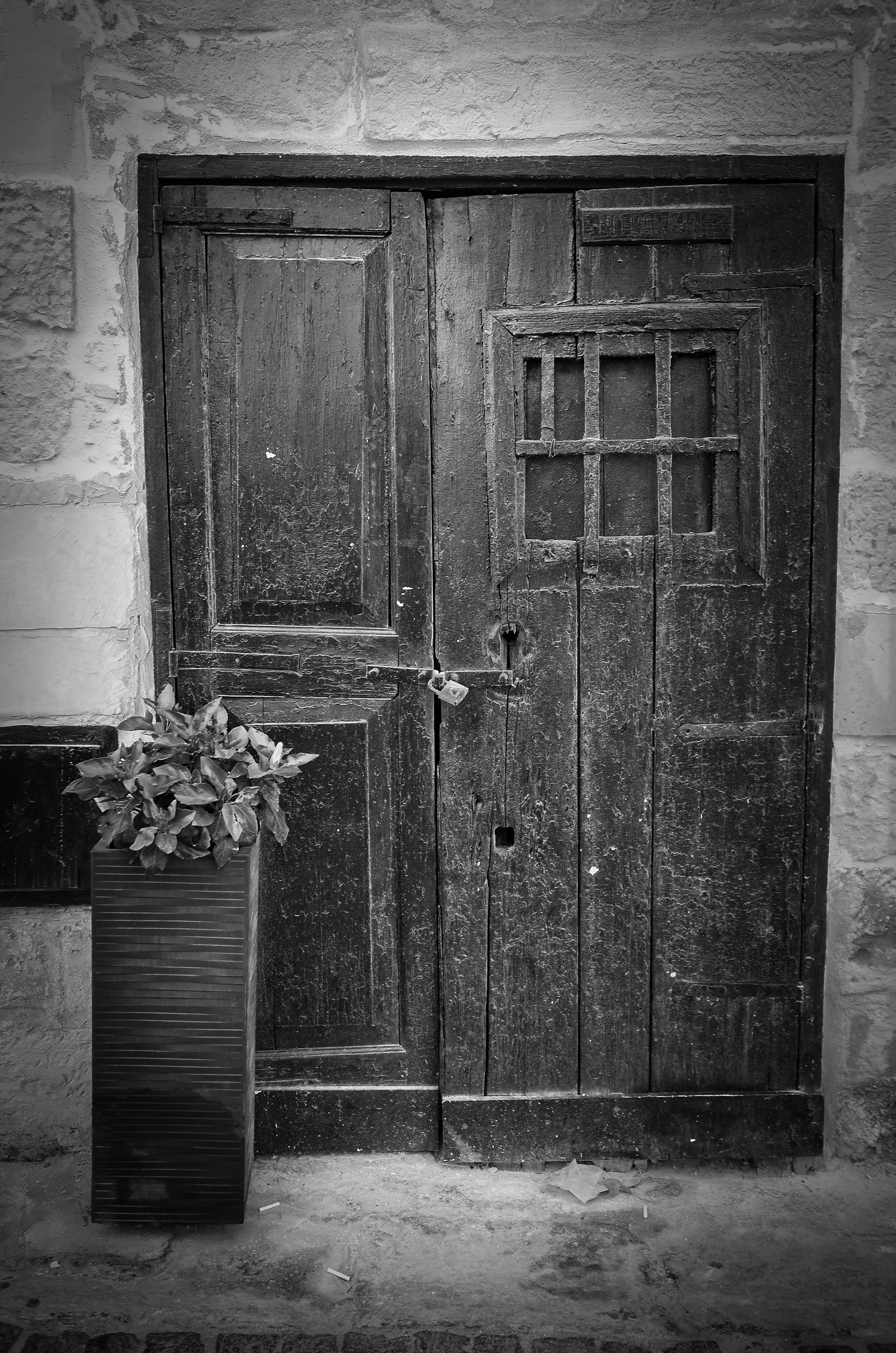
What the Internet Thinks Street Photography Is
Do me a favour. Open Google Images or Flickr if you have an account and type in "black and white street photography." Go on. I'll wait.
What you get back is a fairly consistent aesthetic. Crushed blacks. Blown highlights. A lone silhouette in a perfectly symmetrical archway. Someone running across a zebra crossing at a dramatic angle. Deep shadows that make an ordinary afternoon look like a film noir. Everything punchy, everything graphic, everything dialled up to eleven.
It's striking, certainly. Some of it is genuinely excellent. But a significant chunk of it isn't really documenting anything — it's manufacturing atmosphere. There's a difference, and it's worth saying out loud.
What you're looking at, in a lot of those images, is post-processing doing the heavy lifting that composition and timing couldn't quite manage. Raise the contrast enough, crush the blacks hard enough, and a fairly unremarkable street scene suddenly looks dramatic and intentional. The problem is that real light doesn't look like that. Real streets don't look like that. And the people in those images often don't look entirely unaware either — there's a staged quality to the best-positioned silhouettes, a too-perfect quality to the decisive moments, that makes you wonder whether the "candid" element is doing as much work as it claims to be.
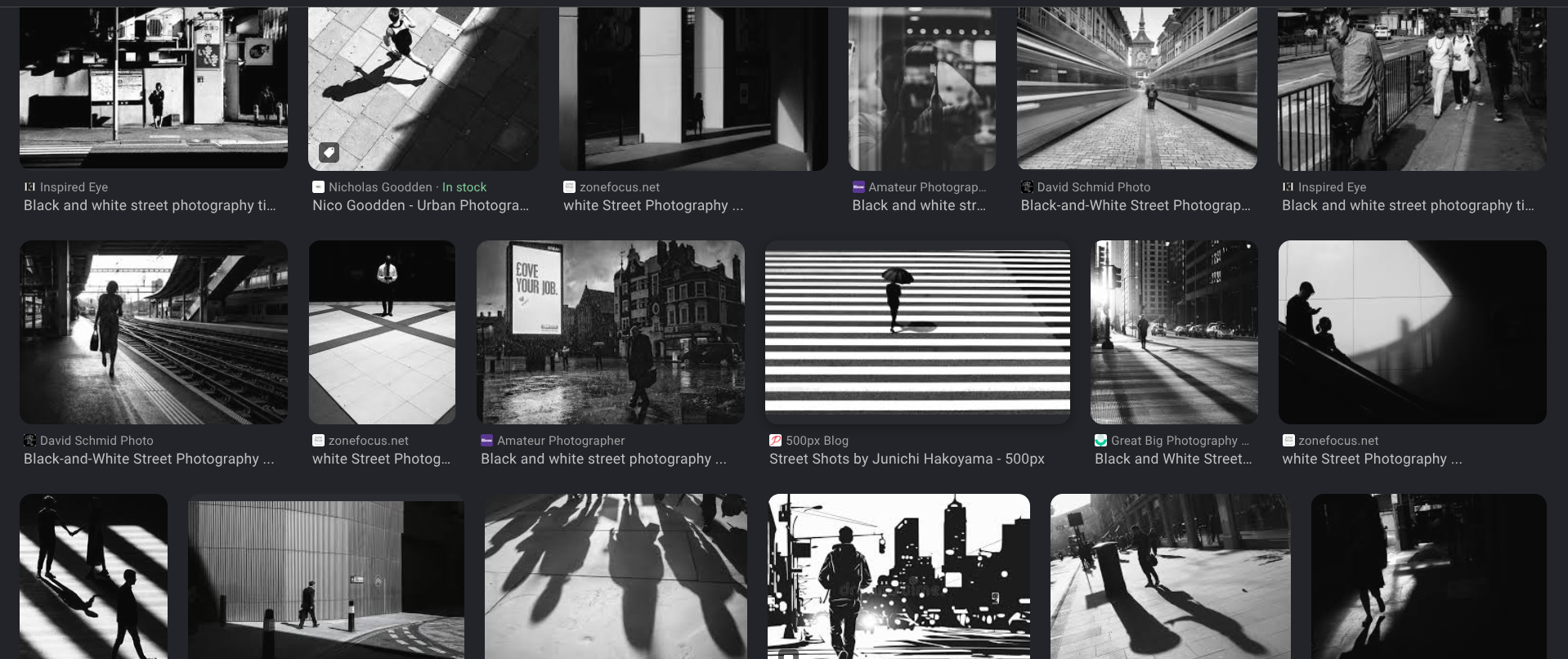
I'm not saying none of it is authentic. I'm saying it's worth questioning. And I'm saying that as a genre identity, it has become so self-referential that it's started to eat itself. People search for street photography, they see this look, they go out and try to recreate it, they post it, and it becomes part of the search results that the next person sees. The aesthetic feeds itself in a loop that has very little to do with actual observation and rather a lot to do with a recognisable visual brand.
The YouTube and Social Media Problem
The issue gets compounded by the way street photography is taught and discussed online.
YouTube is full of street photography content. Some of it is genuinely useful — photographers talking about their approaches, their cameras, their thought processes. But a fair amount of it is built around the aesthetic first and the philosophy second. The camera gear reviews. The "day in my life shooting street" vlogs with a carefully selected soundtrack. The compilations of great shots that all happen to look identically dramatic. The tutorials on how to get that high-contrast monochrome look in post.
What you don't see as often is the slower, quieter conversation about what street photography is actually for. About documentation. About the social and historical value of capturing everyday life as it actually is, not as it looks when you've put it through a Lightroom preset. About the photographers who came before social media and weren't trying to get views — they were trying to record something.
The risk is that the format selects for content that performs well visually on small screens. High contrast performs well. Dramatic silhouettes perform well. Quiet, considered, tonally nuanced images of ordinary life are harder to click on when you're scrolling at speed. So the algorithm, in its infinite wisdom, gradually shapes what people think the genre is.
And what it shapes it into is a look, not a philosophy.
Did the Founders Even Want This?
This is where it gets interesting.
The photographers who effectively invented the modern understanding of street photography — Cartier-Bresson, Robert Frank, Vivian Maier, Eugène Atget before them — were not unified by a visual style. They were unified by an approach. They went out into the world and paid attention. They recorded what was there. Some of it was gritty and chaotic. Some of it was quiet and lyrical. Frank's Americans was raw, often technically imperfect, deliberately anti-establishment in its refusal to be beautiful in the expected way. Atget spent decades photographing Parisian streets, architecture, windows, staircases — barely any people — and is considered one of the foundational figures of the genre.
None of these photographers were working toward a shared aesthetic. If anything, they were working against the prevailing aesthetic of their time, whatever that happened to be. The high contrast thing that now defines "street photography" to a generation of online followers would have been completely alien to many of them. Cartier-Bresson used available light and printed with the full tonal range. Maier's work has a gentleness to it, an intimacy, that is entirely absent from the graphic noir style that dominates Google Images.
So no, I don't think the founders wanted this. But here's the complicated part.
Genres Evolve. That's Not Necessarily Wrong.
I want to be careful here, because there's a version of this argument that tips into nostalgia and gatekeeping, and I don't want to go there.
Genres do evolve. Photography as a whole has changed enormously since 1858, and the idea that any genre should be frozen at the point of its founding is both unrealistic and slightly daft. Street photography in the era of smartphones is genuinely different from street photography in the era of the Leica. The ubiquity of cameras means almost everyone is at least partially aware of being potentially photographed in public. The nature of "candid" has shifted as a result. The tools have changed. The audiences have changed. Of course the work itself would change.
And some of what the internet has done with street photography is genuinely interesting as a development of the form. The emphasis on graphic composition, on strong light and shadow, on the city as a visual environment rather than just a social one — these are legitimate creative choices. There are photographers working in this high-contrast style who are making serious, considered work that adds something to the tradition.
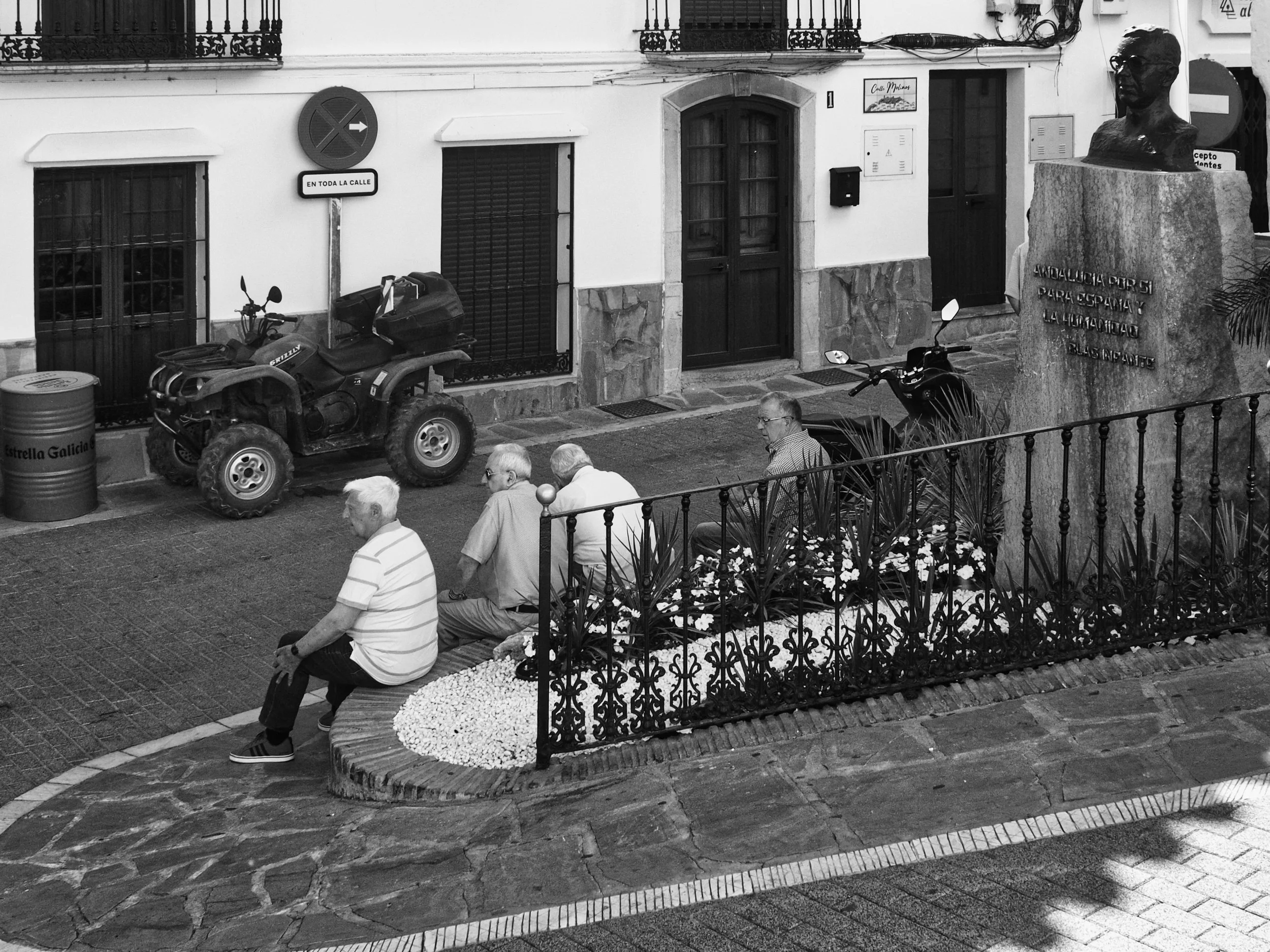
The problem isn't that the aesthetic exists. The problem is that it has been flattened into the only acceptable version of street photography in the popular imagination. And in the process, everything that doesn't look like that — the quieter work, the documentary work, the observational work that doesn't announce itself with drama — gets pushed to the margins or not recognised as street photography at all.
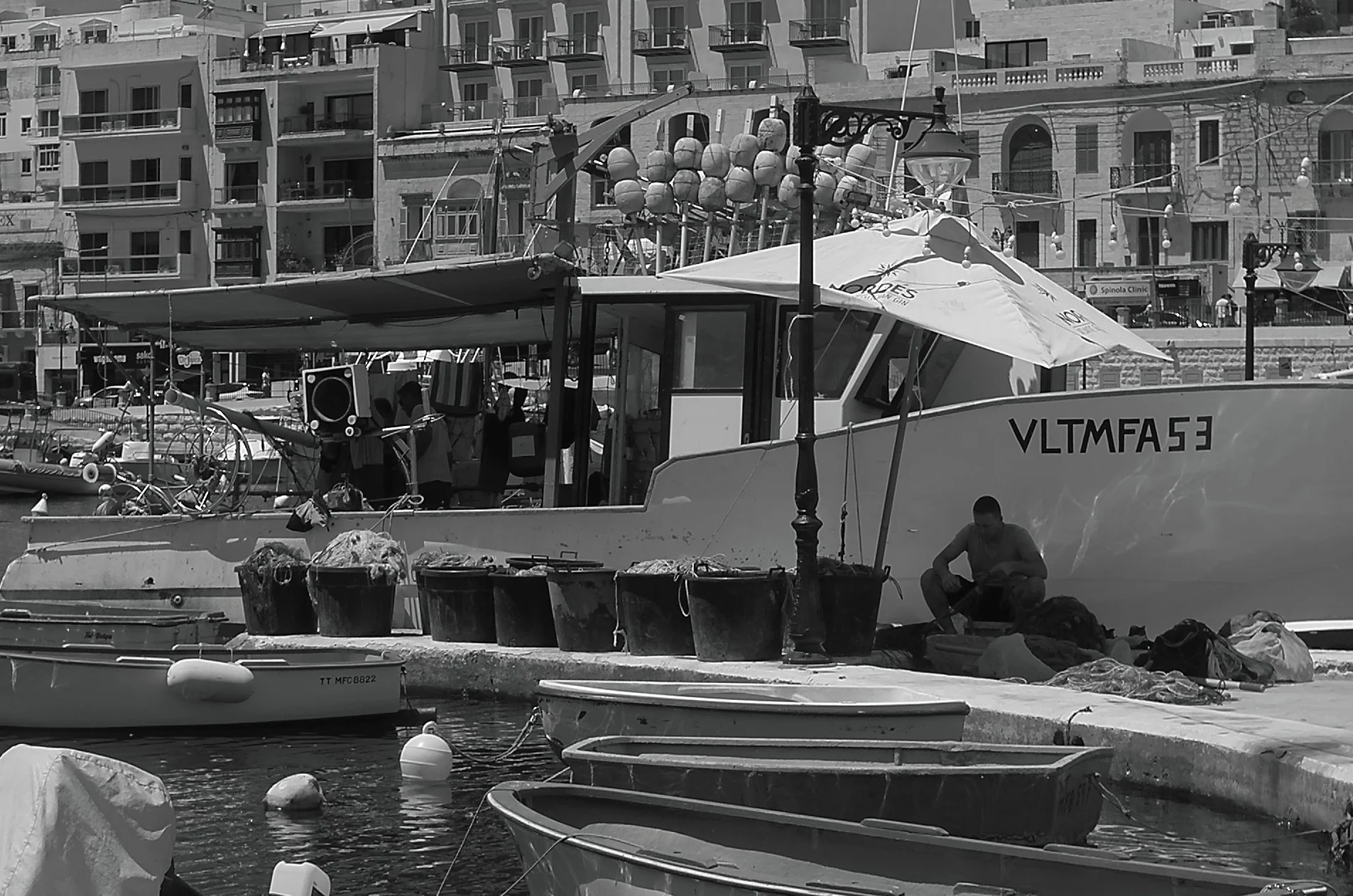
Which is how you get a situation where a Google Images search for "black and white street photography" produces page after page of manufactured noir, and someone walking through a Maltese fishing harbour photographing a fisherman mending nets and a row of ancient doors and the particular quality of light on whitewashed walls might look at that search result and think: oh, that's not what I do then - yes I am talking about me here.
So What Is It, Really?
I've been around this enough times now that I've stopped trying to force a single answer.
What street photography is, at its best, is a record of the world as it actually is. Public spaces. Real people or the traces of real people. A moment of genuine observation rather than manufacture. The rest — the equipment, the style, the decision to shoot colour or monochrome, the degree of contrast, whether you're in a city or a coastal village or a market town — is up to you.
What it isn't, despite what the internet suggests, is a specific visual look. The genre does not require crushed blacks. It does not require a lone figure in a geometrically satisfying position. It does not require drama. Some of the most powerful street photographs ever made are almost painfully quiet.
The tendency to equate street photography with a graphic, high-contrast black and white aesthetic is understandable — it photographs well on screens, it reads clearly at thumbnail size, it's been reinforced by years of social media algorithms selecting for visual impact. But confusing the dominant internet aesthetic with the actual tradition is like confusing a movie poster with the film.
The real thing is broader, stranger, more interesting, and considerably more honest than the version you'll find in most YouTube thumbnails.
Which brings me to the question I've been circling around this whole time — where does my own work fit into all of this? Do my images of Maltese harbours and Andalusian villages and Chiltern streets qualify as street photography? Do I even want them to?
That's a question for the next blog. But I'll give you a clue: the answer involves admitting something I should probably have said much sooner.
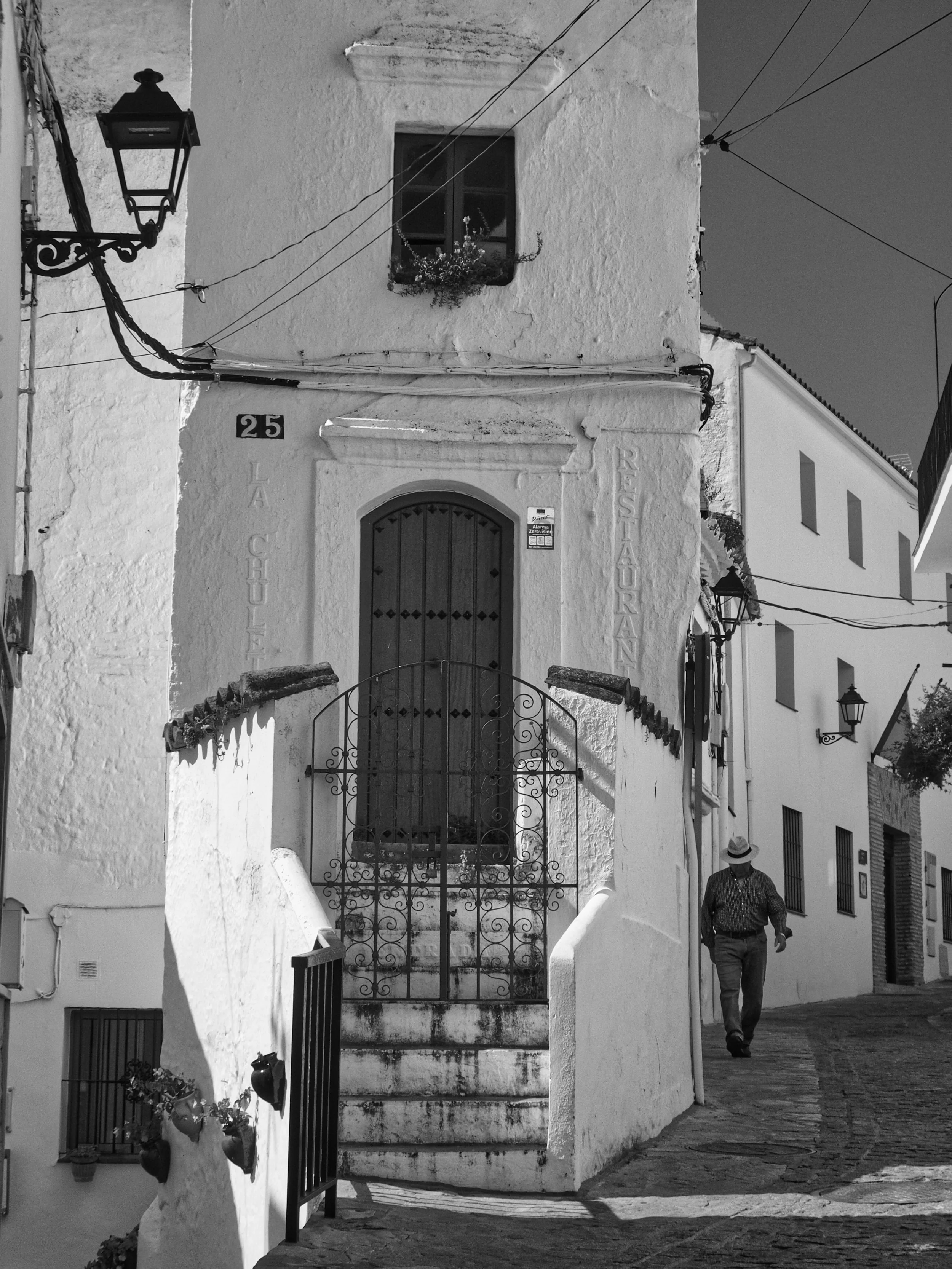
Next up: I'm Not a Street Photographer (And That's Fine)